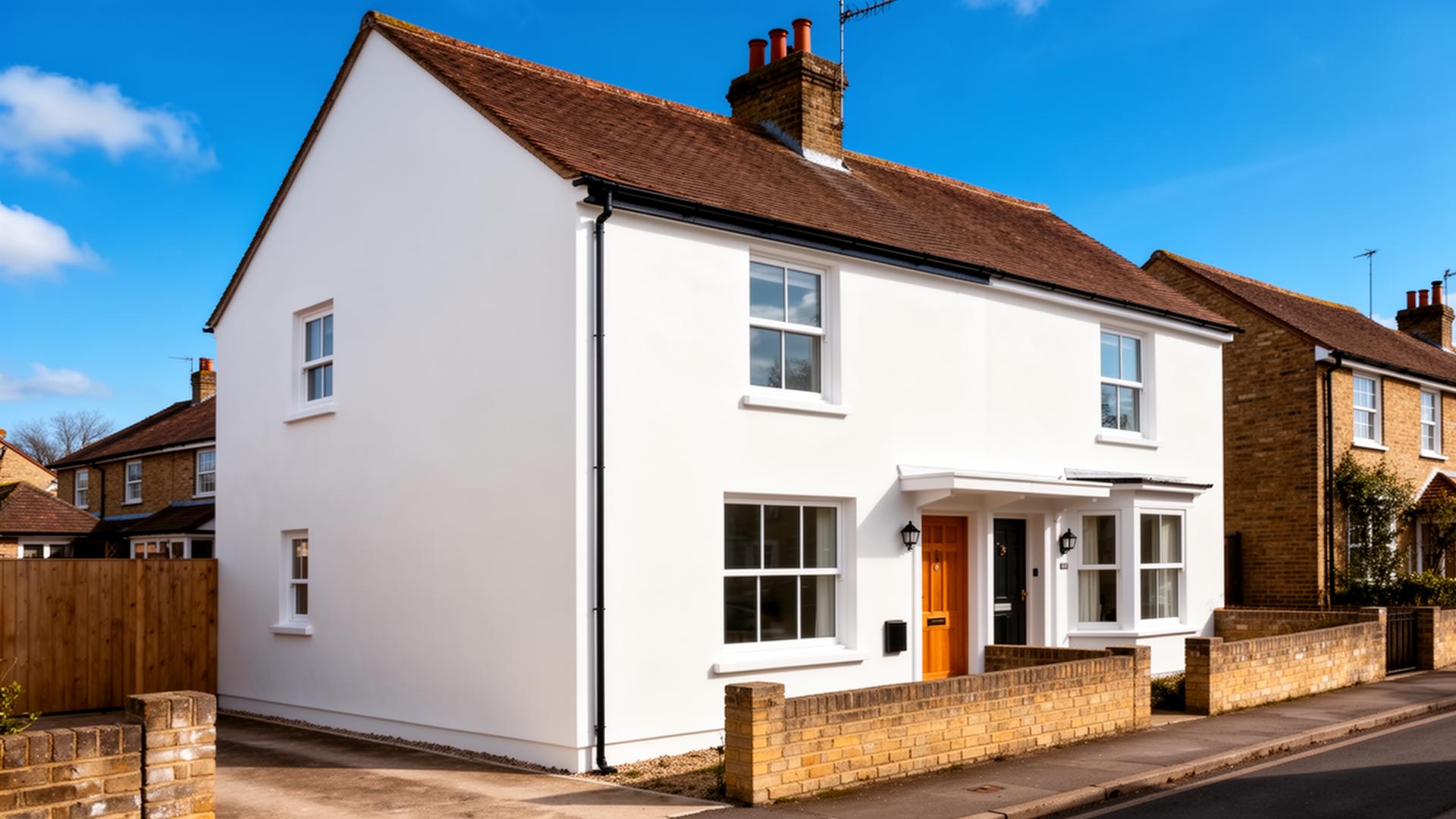
Monocouche works particularly well on new-build masonry across Halifax where the substrate is dimensionally stable and the spec calls for a single-coat coloured finish.
Why Monocouche in Halifax?
Through-coloured — pigment runs through the whole 15mm-plus thickness, so chips and abrasions don't read as bright scars.
Local context: Halifax, West Yorkshire
Steep stone-built terraces clinging to the valley sides, with elevated semis above — much of the stock is solid-wall and well suited to EWI. High rainfall and wind-driven moisture on west elevations — vapour-open systems are critical. We cover the full West Yorkshire area from HX1 outwards, including Sowerby Bridge, Hipperholme, Northowram, King Cross, Pellon and the wider postcodes (HX1, HX2, HX3). Most Halifax jobs are surveyed within 48 hours — we know the streets, parking constraints around landmarks like Piece Hall, and the typical substrates we'll find on the wall.
Benefits
- Single-coat application — quicker than two-coat systems.
- Compatible with most masonry substrates.
- Long service life when properly detailed.
- Through-coloured cement system — no repaint cycle.
- Robust, hard-wearing surface.
- Traditional scraped aesthetic suits older properties.
Local considerations
- Not the best choice over EWI boards — silicone TC handles that better.
- Monocouche needs proper expansion joints — without them, larger panels in Halifax will crack at stress points.
- It's cement-based, so it's heavier and less flexible than silicone — substrate stability matters more.
- Application is weather-critical: we won't apply monocouche in Halifax in rain, frost or strong direct sun.
- Colour consistency depends on batch control — we order from a single batch where possible for large Halifax jobs.
Our process in Halifax
- Survey, written quote with itemised elevations.
- Scaffold, sheet, isolate.
- Fit beads, joints, primer to substrate.
- Apply monocouche in continuous panels.
- Scrape-finish at correct cure window.
- Final inspection and photo handover.
Areas we cover from Halifax
We work across Halifax (HX1, HX2, HX3) and the surrounding areas:
Frequently asked questions
Can you apply monocouche over existing render?
Generally we recommend stripping back to a sound substrate. Bonding monocouche over a failing scratch coat just transfers the failure forward.
How long does the work take?
Single-coat application is faster than two-coat — typical 3-bed semi in 3–5 working days plus scaffold.
Will I need planning permission?
Usually no for like-for-like re-renders. Listed buildings or conservation areas in Halifax need checking — we'll advise on survey.
Is monocouche better than silicone in Halifax?
Neither is universally 'better'. Silicone is more flexible and self-cleaning; monocouche is more traditional, heavier, and often cheaper per m². We'll recommend the right one on survey.
How long does monocouche last?
Properly installed with proper expansion joints, 25+ years is realistic. Without those joints, cracking can appear within 5.
Can monocouche crack in Halifax weather?
Any cement-based render can crack if expansion joints are missed or the substrate moves. We design joint layouts on every job.
Call now to lock in a survey slot. We'll discuss colour, finish, scaffold and timing on the visit.
We've installed monocouche across Halifax for years. The difference between a 5-year and 25-year life is the detailing — that's where we earn our money.