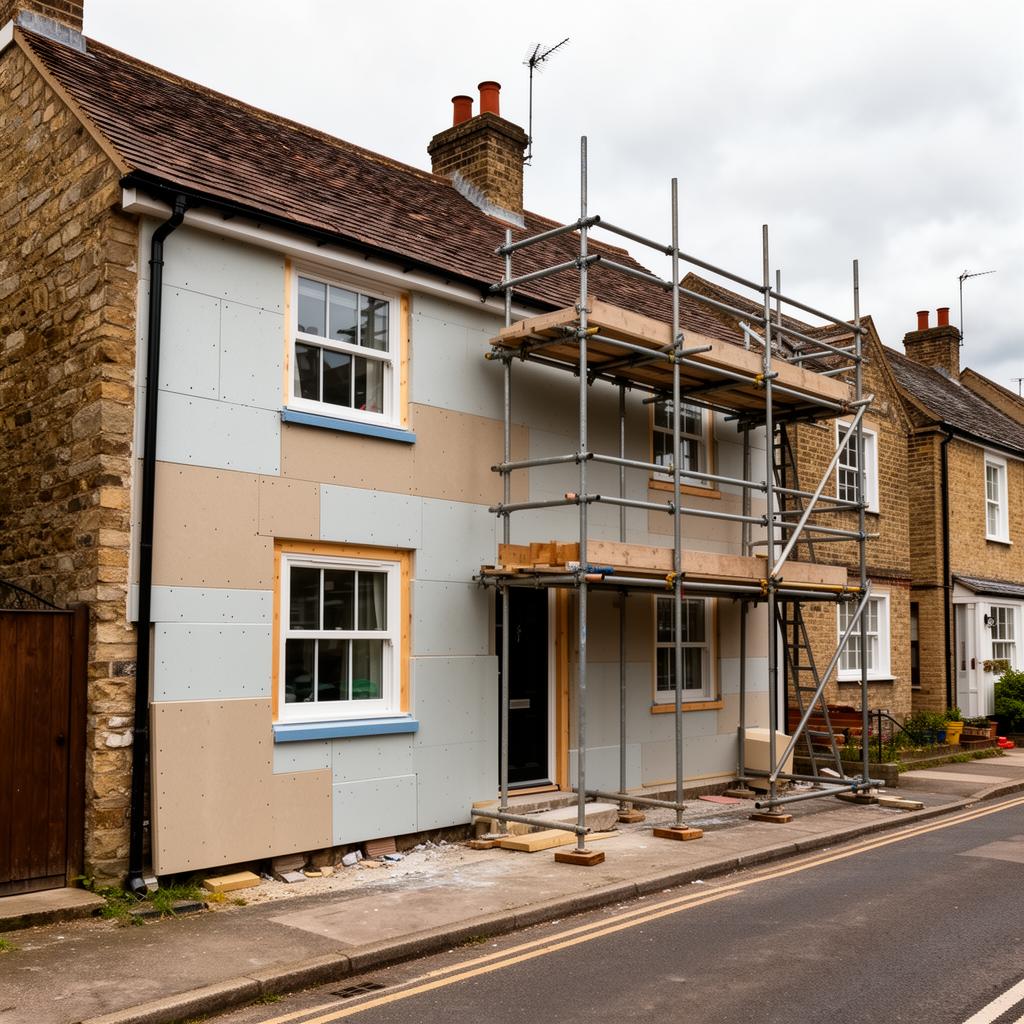
If your Doncaster property was built before about 1930, it almost certainly has solid walls — no cavity to fill. EWI is the only way to properly insulate it without losing internal space.
Why EWI in Doncaster?
Significantly improves EPC rating, which matters increasingly for Doncaster rental and resale value.
Local context: Doncaster, South Yorkshire
Large stock of interwar and postwar semis with original pebbledash; estate-scale render refreshes are common. Flatter, drier conditions than the Pennine fringe, but east-elevation weathering still drives works. We cover the full South Yorkshire area from DN1 outwards, including Bessacarr, Cantley, Wheatley, Bentley, Sprotbrough and the wider postcodes (DN1, DN2, DN4, DN5, DN6). Most Doncaster jobs are surveyed within 48 hours — we know the streets, parking constraints around landmarks like Doncaster Minster, and the typical substrates we'll find on the wall.
Benefits
- Long-life system when detailed properly.
- Major reduction in heating bills.
- Eliminates cold bridging and most internal condensation.
- Brand-new render façade included.
- Significant EPC uplift.
- Improves acoustic performance.
Local considerations
- Plan for moved rainwater goods, soil stacks and meter boxes — the project is more than just 'boards and render'.
- EWI on a damp wall just traps the damp. Cure the damp problem first.
- EWI changes the external footprint of the building by 100–200mm — windows, sills, rainwater goods and roof overhang all need designing in.
- Get the breathability right — for older solid-wall properties in Doncaster, mineral wool with a silicone topcoat is usually safer than EPS.
- Reveals, sills and drip beads are where EWI fails. We detail these properly; many cheap installers don't.
Our process in Doncaster
- Detailed survey — substrate test, U-value calc, thermal modelling if needed.
- Design board thickness, finish, beads, fixings.
- Scaffold and full mask-off.
- Adhesive-bed and mechanically fix insulation boards (typically EPS or mineral wool).
- Base coat with embedded mesh, all corners and reveals detailed.
- Through-coloured silicone topcoat — sample on the wall first.
- Snag, photo handover, scaffold strikes.
Areas we cover from Doncaster
We work across Doncaster (DN1, DN2, DN4, DN5, DN6) and the surrounding areas:
Frequently asked questions
Are there grants available?
Grant schemes change. Ask on enquiry — if there's an active scheme that fits your Doncaster property, we'll point you to it.
How much can EWI save on bills in Doncaster?
Typically 25–35% off heating demand for solid-wall properties. The exact figure depends on current insulation, heating system, and how the house is used.
What thickness of insulation do you use?
Most Doncaster projects sit between 90mm and 150mm, depending on the U-value target and existing detailing. We size it on survey.
Does EWI need planning permission in Doncaster?
Usually no for like-for-like exteriors on standard housing, but conservation areas and listed properties need checking. We'll advise on survey.
Can EWI fix damp?
EWI eliminates cold-bridging condensation — the most common cause of 'damp' patches on solid walls. It doesn't fix rising or penetrating damp, which need addressing separately.
What's the typical job duration?
Most semis in Doncaster: 2–3 weeks on site including scaffold. Larger detached: 3–5 weeks.
Call now to lock in a survey slot. We'll discuss colour, finish, scaffold and timing on the visit.
If your Doncaster property is solid-wall and cold, EWI is almost certainly the single best upgrade you can make. Get a free survey.